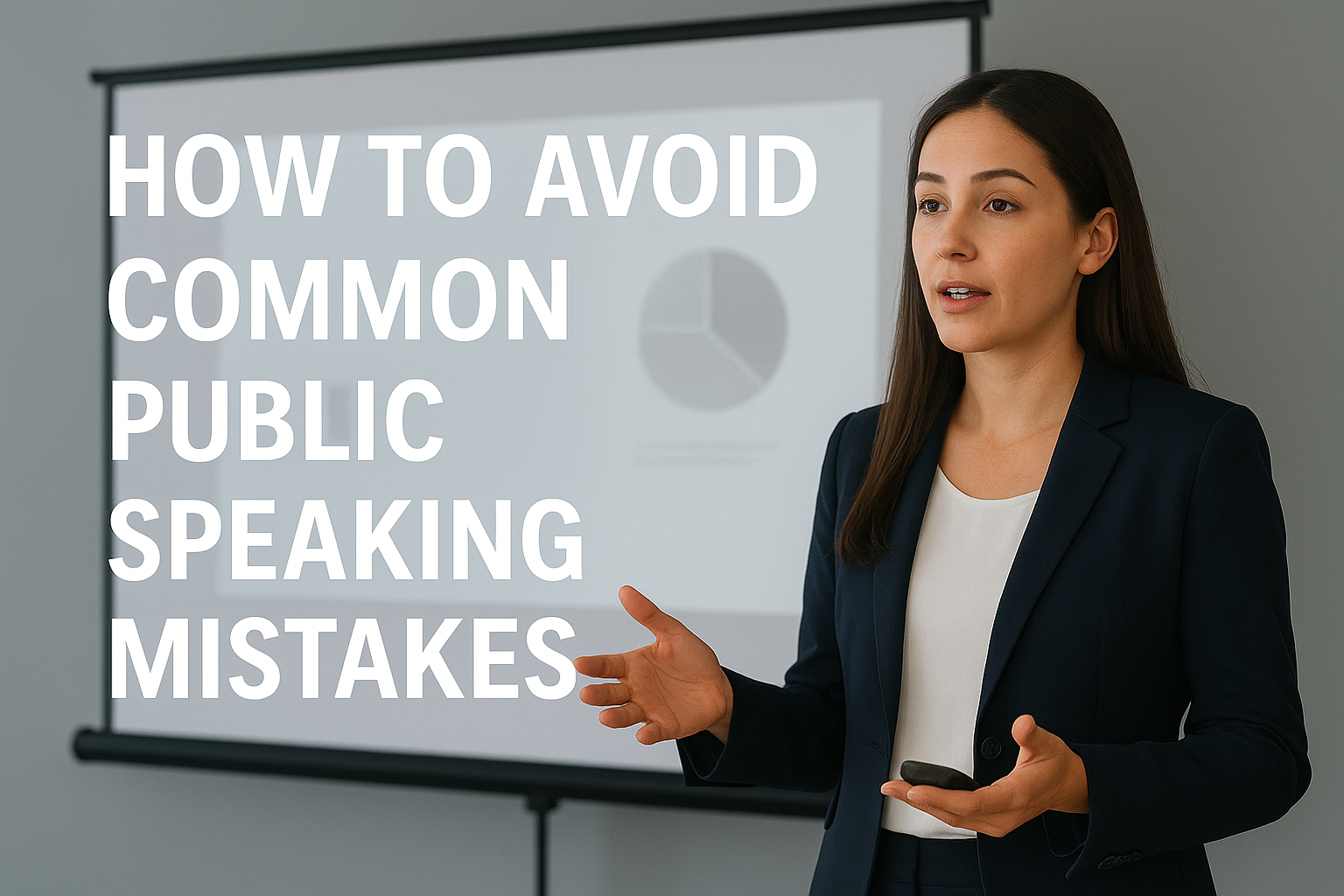
Common Public Speaking Mistakes and How to Avoid Them
Even experienced speakers make mistakes.
I know this because I have made plenty of them myself.
Some years ago, I had the pleasure of delivering an education workshop at the Toastmasters National Conference in Melbourne.
The session was titled How to Be a Calm and Confident Public Speaker, and if I say so myself, I had put together a compelling presentation filled with practical, doable tips.
On the day, I felt surprisingly calm. In fact, I was perhaps a little too confident! Armed with what I believed was a thorough and reliable preparation checklist, I was convinced I had covered every possible contingency.
How wrong was I?
About thirty minutes before my session was due to begin, one of the organisers approached me with unexpected news. Far more people had registered for my workshop than the allocated room could hold. If I was willing to move to the ballroom, they could accommodate everyone. I was assured the change would be seamless, with volunteers on hand to help move my equipment and set everything up again.
Wanting to ensure everyone could attend, I happily agreed. The move was smooth, the room filled quickly, and the session began without issue.
Everything was going beautifully… until I reached a slide with a video clip.
The clip started playing, then froze after just three seconds. I tried again. Same result. I was incredulous. This video had worked perfectly every time I rehearsed. With around one hundred people watching and waiting, I made a quick decision. I abandoned the clip and continued the presentation, verbally explaining the point the video was meant to illustrate.
The session carried on successfully, but I was determined to understand what had gone wrong.
When I arrived home, I opened PowerPoint on my laptop and immediately replicated the error. And then it dawned on me - I had rehearsed my entire presentation on my desktop PC, not on the laptop I used at the conference. The file on the laptop had become corrupted, and I had never noticed.
My checklist had failed me, not because checklists are flawed, but because I had omitted one vital item: rehearse the presentation on the exact computer you will use on the day.
That experience reinforced a lesson I now share regularly.
Preparation is not just about knowing your content. It is about testing your presentation under real world conditions. Same device. Same setup. Same environment.
Public speaking mistakes often come down to small oversights like this.
The good news is that once you recognise them, they are easy to prevent.
Below is a comprehensive guide to the most common missteps and how to avoid them, so you can speak with clarity, confidence and impact.
1. Not Being Prepared
This is one of the most common and costly pitfalls.
Preparation is so much more than casually reading over and running through your slides in advance of your presentation.
It includes having a comprehensive checklist, testing your setup, planning for the unexpected, and being comfortable enough with your content that you can stay grounded in the case of something unexpected happening.
Ensure that you:
Always rehearse under real-life conditions whenever possible. Use the same laptop, remote and file format you will use for your talk. Remember what happened to me in the opening story of this blog post when I failed to rehearse on the laptop I was planning on using in my presentation!
Practise out loud - at least twice. The more times you rehearse your entire presentation the better!! Practice like this is wonderful for helping you familiarise yourself with your material. It also helps to reveal, and thus tweak any awkward phrasing, pacing issues, or transitions.
Have backups: a PDF copy, a USB copy, a cloud backup and a version emailed to yourself.
Arrive early to check sound, lighting, clicker, slides, and room layout. It’s a good idea to meet “the tech person” in advance, so you can overcome any issues that arise in the leadup to your presentation.
Prepare for questions you are likely to receive. And know how to handle any difficult questions that take you by surprise.
Preparation builds confidence because it reduces surprises.
The more you can anticipate potential things “going wrong” the better. That way, you don’t fall apart, since you simply swing into gear, and execute your “Plan B”.
And even if something unexpected does happen, it’s never the end of the world. Just smile, take a deep breath, and know that your audience is on your side!
“By failing to prepare, you are preparing to fail”
2. Overloading the presentation with too much information
This is one of the most common mistakes I see, particularly among subject matter experts and senior professionals.
There is a strong desire to be thorough, to demonstrate credibility, and to cover every possible angle.
This mistake often comes from good intentions.
Many speakers feel they need to “cover everything” to demonstrate expertise.
The result is an audience that feels overwhelmed rather than informed.
Information overload can happen even without slides. It shows up when:
Too many points are introduced at once
Ideas are layered without clear structure
Explanations run long without pause
Audiences can only process so much information at one time.
When too much is delivered, retention drops and attention drifts.
How to avoid this mistake:
Be clear on the one thing your audience must remember
Limit yourself to three main points
Ask, “What does my audience need right now?”
Remove anything that does not directly support your core message
A useful guideline is to ask yourself is: What does my audience need to know, rather than everything I could tell them?
Remember that less is always more - Clarity is far more persuasive than quantity.
3. No clear, core message
Having a clear core message helps your audience follow your thinking. It anchors your structure, guides your points and examples, and gives your presentation purpose.
When you don’t have a strong main message, your audience can get confused and lose interest in your presentation.
How to avoid this mistake
• Write one sentence that summarises your core message.
• Build your supporting points around that core message.
• Review your slides to ensure each one contributes to your purpose.
• Avoid adding ideas simply because they sound interesting.
Clarity leads to confidence. When your message is defined, your delivery becomes more focused and more engaging.
4. Lacking a strong opening or closing
Your opening and closing are like bookends to your presentation. Both of them need to be compelling.
Your opening sets the tone.
Don’t start with a weak opening, otherwise your audience may lose attention in those first few critical minutes.
Your closing, on the other hand, determines what people remember.
That’s why you should avoid a lacklustre closing at all costs. Especially if you want to persuade your audience to take some form of action.
Audiences pay closest attention at the beginning and end of a presentation.
Research in communication studies refers to this as the primacy and recency effect.
How to avoid this mistake
• Begin your presentation with a bang, say with a story, a question, or an activity.
• State your message early.
• End by reinforcing your key point.
• Leave the audience with one actionable idea.
Read this post on tips to start your presentation with a bang.
Read this post on tips to end your presentation in style.
5. Overloading slides with information
Just like having too much information in your presentation is a big no-no, so too is overloading your slides with too much text.
We have all seen a slide so dense with text that you almost need a magnifying glass to read it!
When your audience is reading instead of listening, engagement drops. Too much text creates cognitive overload, and your message becomes harder to follow.
The same applies to slides with long bullet lists.
How to avoid this mistake:
• Limit each slide to one idea.
• Replace paragraphs with succinct statements.
• Swap text for compelling visuals: photographs, charts, graphics or icons.
• Make your slides a backdrop, not a script.
Clean slides support your message - they keep the audience focused on you and your insights, not on deciphering content on a busy screen.
6. Forgetting to warm up your voice
Many speakers prepare their slides, but forget to prepare their voice.
Your voice communicates confidence, clarity and intention.
A warmed-up voice allows you to vary pitch, pace and tone more effectively.
How to avoid this mistake:
• Do gentle humming or lip trills before speaking.
• Read a paragraph of your script aloud.
• Practise taking slow, deep breaths to support your sound.
• Drink water and avoid rushing straight into the talk.
A well-prepared voice helps you speak with greater ease and authority.
7. Neglecting audience engagement
Even a polished presentation can fall flat if the members of your audience feels like passive observers, rather than active participants.
Engagement is what transforms a talk from informative to memorable. People retain information more effectively when they interact with it. Not only that, but they enjoy your presentation so much more when it is engaging.
How to avoid this mistake:
• Ask rhetorical or reflective questions.
• Invite a quick show of hands.
• Share a short story or relevant example.
• Pause to allow the audience to absorb your message.
• Maintain eye contact across the room.
These small moments of interaction can shift the energy, and keep your audience engaged and happy.
Here is a post with some top tips to make your presentations more engaging.
“The wise man learns from the mistakes of others”
8. Going over time
Running over time is one of the most common and most visible presentation missteps.
Respecting time demonstrates both professionalism and respect towards your audience.
Audiences lose concentration when talks exceed the allocated window.
Meeting schedules fall behind, and your final points may be rushed.
How to avoid this mistake:
• Rehearse with a timer.
• Build buffer space into your talk.
• Prioritise your key messages, so you can trim if needed.
• Aim to finish a few minutes early — it feels crisp and confident.
When you honour the time that has been allotted for your presentation, you leave a stronger final impression.
9. Speaking too fast
If you get nervous, your pace increases. Your words blend together, and the audience struggles to follow what you are saying.
How to avoid this mistake:
• Pause more often than feels natural.
• Slow down when explaining complex ideas.
• Ask for feedback: “Is my pace comfortable for everyone?”
A nice, even pace helps your message land.
It also gives you space to think, breathe and connect.
10. Using an overload of filler words
Filler words such as um, uh, you know and like are incredibly common, and yes, they can be distracting and annoying.
Used occasionally, they are perfectly fine. You are only human. No one expects you to be perfect!
But when used frequently, filler words can undermine your credibility and distract from your message.
Nervousness, a lack of confidence, or an unconscious habit of speaking quickly can result in overuse of fillers.
Helpful strategies to reduce filler words in your speech include:
Slowing down your speech
Replacing filler words with a pause. Pausing gives you time to collect your thoughts and present your next idea more confidently.
Practising transitions between ideas
Recording yourself to identify patterns in where you use filler words and which ones you use the most often. This awareness is key to kicking the filler word habit.
Silence is powerful.
A pause sounds confident. A filler word rarely does.
This post elaborates on the filler word problem, and how to eliminate them from your speech.
11. Relying too heavily on notes
Notes are helpful as a support, but reading from them can disconnect you from the audience.
How to avoid this mistake
• Use notes as prompts, rather than as scripts.
• Create a simple outline with keywords.
• Practise your presentation multiple times until you can deliver your message conversationally.
• By all means, keep your notes nearby as a reference, but avoid holding them if it restricts movement.
Remember - the more present you are, the more your audience will connect with you.
12. Not Tailoring the Message to the Audience
Delivering a one-size-fits-all speech can fail to connect with your audience.
If your content doesn’t speak to their interests, background, or knowledge level, they’re unlikely to engage with your message.
Speakers often assume that their audience will understand their topic the same way they do. They may not take the time to research their audience’s preferences or knowledge level.
How to avoid this mistake:
Research your audience in advance. Who are they? What are their interests, concerns, and levels of expertise? Tailor your language, examples, and depth of explanation to meet their needs. If you're speaking to a group of beginners, avoid jargon and overly technical details. Conversely, if you're addressing experts, make sure you challenge them with new insights or advanced concepts.
In Closing
Mistakes can be incredibly valuable for personal growth.
It is by making mistakes, and understanding why things went wrong, that we continue to improve.
Just look at my Toastmasters presentation. From that single rehearsal error, I learned the importance of practising my presentation under real-life conditions.
The benefit of knowing about these common mistakes, and how to correct them, is that your success can now be fast-tracked - You get to learn the lessons without having to experience every misstep first-hand.
As Otto von Bismarck once said, “The wise man learns from the mistakes of others.”
My advice is simple. Work through these tips one by one, over time, until they become second nature.
And when they do, you will be unstoppable.
© 2026 Susan Weser. All rights reserved.
Susan Weser is the Founder of Speaking2Win, a boutique public speaking and presentation skills consultancy, based in Melbourne, Australia. Susan’s mission is to demystify public speaking and presenting. She loves to fast-track her clients’ public speaking success, empowering them with the skills and confidence to excel in all their public speaking endeavours.